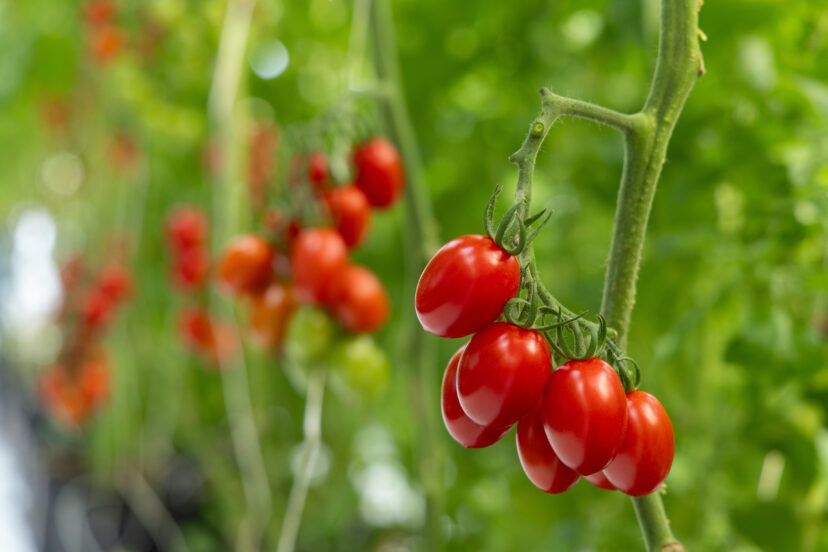
Sanatech Life Science Co., Ltd. (Headquarters: Minato-ku, Tokyo; President & CEO: Shimpei Takeshita), a biotech startup originating from the University of Tsukuba in Japan, announces that it has completed the official notification process in Japan with the Consumer Affairs Agency (CAA) and the Ministry of Agriculture, Forestry and Fisheries (MAFF) for its breakthrough tomato lines (#70a-23 and #6-16).
Developed using CRISPR/Cas9 genome editing technology (Note 1), these lines simultaneously achieve high concentrations of accumulated “GABA” (Note 2) and “cis-lycopene,” a form of lycopene featuring dramatically superior human absorption.
In this development, an approach modifying two genes simultaneously (multi-target gene editing) was adopted, yielding significant results toward the social implementation of next-generation agricultural crops that stack multiple useful traits in a single variety.
Prior to notification in Japan, Sanatech Life Science Co., Ltd. completed prior consultations regarding the handling as food with the Office of Health Policy for Novel Foods, Food Safety Standards and Evaluation Division, Consumer Affairs Agency, as well as prior consultations regarding the impact on biological diversity with the Agricultural Produce Safety Division, Food Safety and Consumer Affairs Bureau, Ministry of Agriculture, Forestry and Fisheries (MAFF). As these prior consultations have now concluded, the official notifications have been submitted to Japanese authorities.
While commercial distribution is intended for human consumption, notifications have also been submitted to the Livestock and Fisheries Safety Division, Food Safety and Consumer Affairs Bureau, MAFF, regarding potential feed utilization of non-standard fruits.
The notification information is disclosed on the respective Japanese government ministry websites listed below:
(1) Regarding Food Safety:
CAA, Food Safety Standards and Evaluation Division
(2) Regarding Impact on Biological Diversity:
MAFF, Food Safety and Consumer Affairs Bureau, Agricultural Produce Safety Division
(3) Regarding Feed Safety:
MAFF, Food Safety and Consumer Affairs Bureau, Livestock and Fisheries Safety Division
Development Background and Key Features of This Technology
Our company has been promoting the variety development and social implementation of tomatoes that richly accumulate “GABA,” which attracts global attention as a functional component contributing to health maintenance.
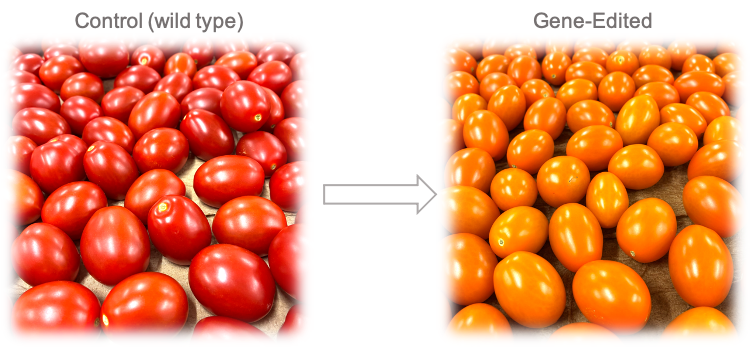
In this project, in addition to controlling genes involved in GABA synthesis, we simultaneously modified the gene for an enzyme governing carotenoid metabolism. As a result, we succeeded in breeding next-generation tomatoes that stack both “High GABA,” contributing to blood pressure suppression, and “High Cis-Lycopene,” superior in absorption efficiency, all at once.
About Cis-Lycopene
Generally, most of the red pigment “lycopene” contained in raw tomatoes naturally exists as “trans-lycopene (All-trans-lycopene),” which has a straight molecular structure. On the other hand, most of the lycopene present in the human body and animal tissues is “cis-lycopene (cis-lycopene),” which has a bent molecular structure. Cis-lycopene has been reported to exhibit extremely high bioavailable absorption (approximately 8.5 times higher) compared to ordinary trans-lycopene (Cooperstone et al., 2015).
In #70a-23 and #6-16, by suppressing the metabolic conversion from cis-form to trans-form through gene modification, we succeeded in accumulating “cis-lycopene” at high concentrations in the fruit (approx. 3.3 to 3.4 times the wild-type in #70a-23, and approx. 2.1 to 2.6 times in #6-16).
Lycopene is known to increase its absorption rate when cooked with heat, but with these lines, efficient bioavailability and intake of lycopene can be expected even when eaten raw.
Sales Plan and Labeling
Sales plans are currently to be determined.
When launched in the market, similar to the HIGA GABA Tomato currently sold in Japan, the following mark will be displayed on home gardening seedlings and food products to ensure full consumer transparency that they were developed using genome editing technology.
Contact Information
Sanatech Life Science Co., Ltd.
E-mail: info@sls.sanatech-seed.co.jp
Notes
Note 1: What is CRISPR/Cas9?
Since the discovery of the double helix structure of DNA in 1953, the genetic structures of many organisms—including humans, animals, and plants—have been studied in detail, and the specific roles of different genes continue to be discovered. Following research by scientists worldwide, in 2012, Emmanuelle Charpentier of Umeå University in Sweden and Jennifer Doudna of the University of California, Berkeley in the United States developed the genome editing technology “CRISPR/Cas9.” This technology enables the accurate mutation of target genes alone without introducing foreign DNA from other species into the organism’s DNA. Compared to conventional breeding technologies, this allows for more efficient variety development. Holding great potential for the development of next-generation agricultural crops, this technology is expected to contribute to a sustainable food supply while improving food quality in terms of nutrition, processing, storage, and health (such as reducing allergenicity). Dr.Emmanuelle Charpentier and Dr.Jennifer Doudna were awarded the 2020 Nobel Prize in Chemistry for the development of the “CRISPR/Cas9” genome editing technology.
Sanatech Life Science Co., Ltd. uses this technology under non-exclusive research and commercial licenses from Corteva Agriscience and the Broad Institute (Broad Institute of MIT and Harvard).
Note 2: What is GABA?
GABA (gamma-aminobutyric acid) is an amino acid known as an inhibitory neurotransmitter. It has been reported to have effects such as suppressing blood pressure elevation and relieving stress.